
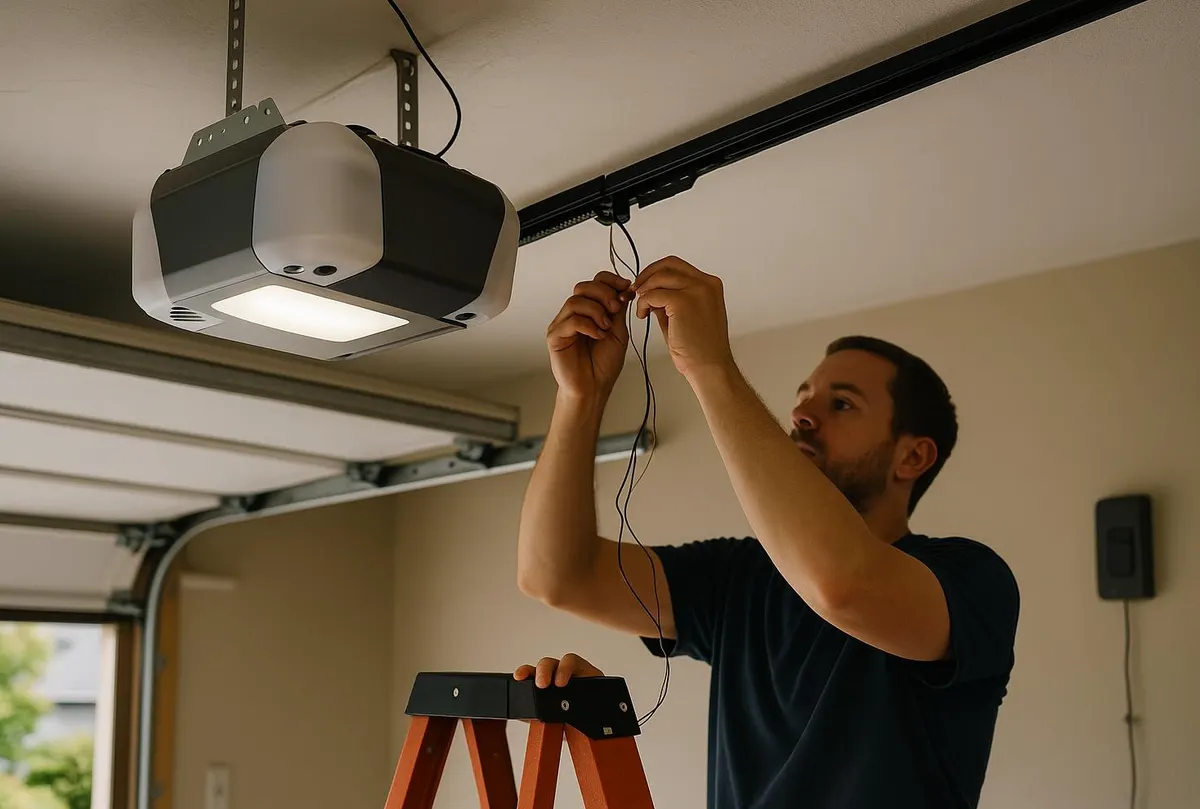
You hit the wall button on a cool November morning, coffee in hand, and instead of rising smoothly, the door lurches, groans, hangs for a second like it's thinking it over, then crawls up the track. By afternoon, once the garage has warmed up, it seems to loosen up and move almost normally. If that sounds familiar, your door isn't broken in the way a cracked panel is broken — it's telling you something about how desert heat and desert cold are working against each other on the same hardware.
What You'll Notice First
Before you start diagnosing causes, it helps to pin down exactly what the door is doing, because the symptom points to the fix.
- Hesitation at the start of travel — the door sits still for a beat before it moves, as if it needs convincing.
- Grinding or squealing coming from the tracks, rollers, or hinges, worse in the first cycle of the morning and quieter later.
- Uneven movement — one side rises faster than the other, or the door tilts slightly as it travels.
- The opener straining — a louder hum, a slower chain or belt, or the unit reversing the door partway up because it senses too much resistance.
- The door feels noticeably heavier if you try to lift it by hand in the cool morning versus the warm afternoon.
None of these are random. They line up with specific parts that react to the swing between cold desert nights and hot, dry days.
Why Desert Doors Get Sluggish When It's Cool
Here's the order a technician actually works through when a homeowner describes this problem.
1. Track and roller debris
The first thing worth checking costs nothing: look along both tracks for dust, grit, or the fine silt that monsoon storms leave behind even months later. That debris packs into the roller grooves and track lip, and it's often worse at the bottom of the track where gravity and rain runoff deposit it. A quick wipe-down with a dry rag, followed by a vacuum of the track channel, solves more sluggish-door complaints than people expect.
2. Hardened or dried-out lubricant
This is the big one in this climate. Summer heat in a closed garage — well past 100°F for months — bakes standard grease into a gummy, thickened residue, or dries it out entirely depending on what was used. Once overnight temperatures drop into the 40s and 50s, that residue stiffens further, and the rollers, hinges, and springs all resist movement more than they should. The fix is a proper cleaning of old grease off the tracks, rollers, and hinge pivots, followed by a silicone-based or lithium-based garage door lubricant applied specifically to moving metal parts — never the track itself, which should stay clean and dry, not greasy.
3. Worn rollers and hinges
If lubrication doesn't fully quiet things down, the rollers themselves are next. Nylon rollers that have logged years of UV exposure and heat cycling can develop flat spots or dried-out bearings inside, and they'll grind no matter how much lubricant you add. Hinges loosen and wear at the pivot point the same way. A technician checks each roller by hand for play and listens for grinding as the door cycles slowly; worn units get swapped for new rollers and hinges rather than re-lubricated indefinitely.
4. Spring tension
Torsion and extension springs lose a small amount of tension over years of cycling, and cold metal is slightly less forgiving than warm metal, which is why a borderline spring often announces itself for the first time on a chilly morning. If the door feels heavy to lift by hand, lurches unevenly, or the opener strains and reverses, a technician checks spring tension and condition before touching anything else, because a weak or rusting spring is a safety issue, not just an annoyance. Spring replacement means matching the correct wire size and wind for the door's weight and swapping both springs as a pair, even if only one looks worn, since they age together.
5. Opener sensitivity
Openers with aging capacitors or circuit boards sometimes behave worse in cooler temperatures, hesitating on the first cycle of the day or needing a second button press. This is checked after the mechanical parts because it's less common, but it's worth ruling in or out if everything else tests fine.
6. Track alignment
Repeated heat expansion and cool contraction over years can shift track brackets slightly, especially on doors that see direct sun on the garage's exterior wall. Misaligned track causes binding that mimics a lubrication problem but won't resolve with grease alone. A technician checks this last, using a level along both tracks, since realignment is a mechanical adjustment rather than a maintenance task.
When to Call Tucson Garage Door Co
If cleaning and lubricating the moving parts doesn't fix the groaning and hesitation, or if the door feels heavy, uneven, or the opener is straining, it's time to get a technician out rather than keep adding grease. Our Garage Door Maintenance visit covers a full track, roller, and hinge inspection along with proper lubrication of every moving part — the kind of service that catches a tired spring or a worn roller before it leaves you stuck with the door half-open. If the issue turns out to be spring tension, our Spring Replacement service gets the right springs installed as a matched pair, safely and correctly.
If your garage door has started groaning, hesitating, or dragging on these cooler mornings, call Tucson Garage Door Co. We serve Tucson, Oro Valley, Marana, Catalina Foothills, Casas Adobes, Sahuarita, Green Valley, and Vail, and we'll have a technician look it over and get it moving smoothly again.